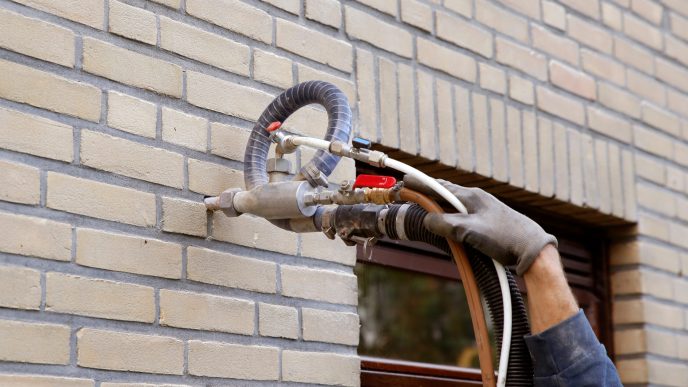
As approximately 35% of heat loss occurs through uninsulated cavity walls, CWI proves to be highly effective in enhancing the thermal efficiency of your home and reducing your energy bills.
Overview
The Importance of Assessment
Cavity walls can be built using various methods, and not all of them are suitable for insulation. Therefore, it is crucial to conduct a comprehensive pre-assessment and borescope inspection before considering it as an option. Some older cavity walls are constructed with brick bonded ties, which are not suitable for cavity wall insulation (CWI) since it permits the transmission of water between the external and internal leaves. The modern approach of using metal ties to connect the wall layers is the preferred method for CWI. Additionally, historical construction techniques have resulted in diverse nuances and uncertainties. For instance, some street-facing walls may be solid, while side walls could have early cavity construction. At times, brick facades may conceal an internal timber structural frame. The key takeaway is that thorough investigations, including measuring wall thickness and identifying construction types, are indispensable in determining the feasibility of installing CWI.
Why We Have Cavity Walls
Traditional construction methods (solid walls) are prone to water penetration and rising damp due to their porous nature. From the 1930s onwards, construction methods changed to reduce this risk by building external walls with cavities, which prevents water from being absorbed on the internal leaf of the wall. Since the 1980’s, new build cavity walls have commonly incorporated partially-filled cavity insulation to meet Building Regulations to improve the thermal efficiency of properties. Those that remain empty are significant (around 5 million homes) and present an attractive retrofit opportunity for many. As a result, CWI has become a widely adopted standalone retrofit measure, however there is still a significant number of homes across the country which remain unfilled.
Benefits & Characterisitics

Minimal disruption

Cost effective solution

Reduced Energy Bills

Reduced Carbon emissions
When is Not Appropriate to Install CWI?
- If there are visible signs of rising or penetrating damp on the inner surfaces of the masonry.
- When there is clear evidence of an obstruction in the cavity or the presence of a brick tie that could potentially channel water toward the inner leaf.
- In cases where structural damage is apparent, such as cracks or spalling in the outer leaf, it is essential to address these issues before proceeding with installation.
- The presence of external render may indicate a prior wall defect that has been concealed, and this needs to be assessed.
- When the cavity is currently used for combustion purposes, such as a fireplace, or for ventilation needs.

What Can I Save?
The table below provides an indication on your energy bills (£/year) and the amount of C02 emissions (kg/year) you could save by installing cavity wall insulation.
| Detached House | Semi-detached House | Mid-terrace House | Detached Bungalow | Flat | |
|---|---|---|---|---|---|
| Typical Installation Cost (£) | £4300 | £2700 | £1500 | £2000 | £1100 |
| Energy bill savings (£/year) | £420 | £240 | £140 | £180 | £120 |
| Carbon dioxide savings (kgCO2/year) | 1100kg | 650kg | 380kg | 490kg | 310kg |
Source: Energy Saving Trust– estimates based on insulating a gas-heated home. Costs may vary significantly depending on the level of work required. Above estimates are based on a typical install, ranging from a small flat to a large, detached house. Prices are based on fuel prices as of July 2025
Cavity Wall Insulation FAQs
How do I know if my home has cavity walls?
Cavity walls are most common in homes built from the 1930s onwards. You can get a rough indication by looking at the brick pattern on the outside — if all the bricks are laid lengthways with no short ends visible, the wall is likely cavity construction. Wall thickness is another indicator: cavity walls are typically around 280mm or more. A retrofit assessor or CWI installer can confirm your wall type during a pre-installation survey.
How is cavity wall insulation installed?
Cavity wall insulation is installed by drilling small holes at regular intervals in the outer leaf of the wall, injecting insulating material through the holes until the cavity is fully filled, and then sealing the holes with matching mortar. The process is minimally disruptive, requires no internal work, and typically takes around half a day for a standard semi-detached home.
How much does cavity wall insulation cost?
Cavity wall insulation typically costs between £1,000 and £4,600 depending on the size of your property. A typical semi-detached house costs around £2,700. Installation is one of the most cost-effective retrofit measures available, with energy bill savings that can pay back the upfront cost within a few years for most homes.
Can cavity wall insulation cause damp?
Cavity wall insulation can cause damp if it is installed in a property that is not suitable for it, or if the installation is carried out poorly. This is why a thorough pre-assessment and borescope inspection is essential before installation. In a suitable, well-built cavity wall with no existing damp or defects, correctly installed CWI does not cause damp. If your home has had CWI installed and you are experiencing damp, it is worth having the installation inspected as the insulation may need to be removed and replaced.
My home already has cavity wall insulation. Can I add more?
If your home already has cavity wall insulation installed, adding more is not usually possible or necessary. However, if the existing insulation was poorly installed or has settled or degraded over time, it may be worth having it inspected. In some cases, existing insulation can be extracted and replaced with a better-performing material. A survey will identify whether this is needed.
Is cavity wall insulation suitable for older homes?
Cavity wall insulation is generally not suitable for homes built before around 1920, as these typically have solid walls rather than cavity walls. Homes built between 1920 and 1935 may have early cavity construction, but these should be assessed carefully as some were built with brick bonded ties that are not suitable for CWI. If you have an older home with cavity walls, a pre-assessment is particularly important.


A Guide to Moisture in Homes
Excess moisture in your home can lead to damp and mould – here's a simple guide to controlling… Read more »
Read more