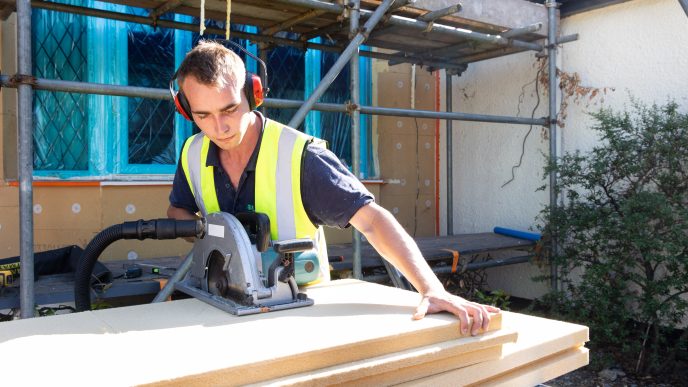
Up to 25% of heat is lost through an uninsulated roof. Insulating your loft, flat roof or converting into a habitable room, is a highly effective strategy at reducing heat loss and substantially saving on your heating bills.
Standard Loft Insulation
Standard loft insulation applies to homes with a pitched roof and an accessible loft space where the ceiling below is flat. It is one of the most straightforward insulation measures available and in many cases can be installed by a competent DIYer.
The recommended depth for mineral wool insulation is 270mm. If your loft already has some insulation but it is shallower than this, a top-up is worth considering as the additional cost is low and the improvement in performance can be significant.
Before insulating, check that your loft is dry and free from damp or condensation issues. Insulating over a damp loft can trap moisture and lead to mould.
Cross-layered mineral wool quilt
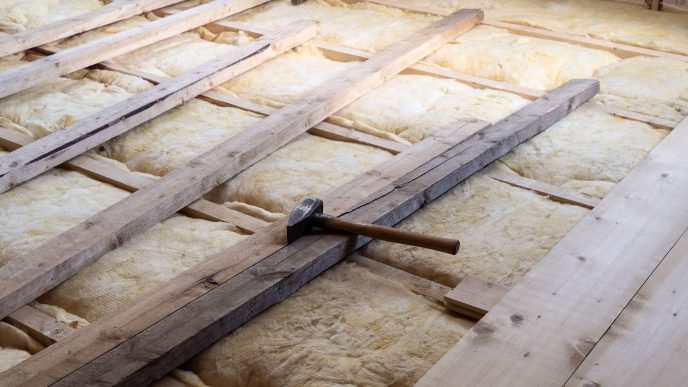
Cross-layered mineral wool quilt is the most common material. Insulation rolls are laid between the joists and then a second layer is run at right angles across the top of them. This cross-layering covers the joists themselves and eliminates thermal bridging through the timber.
Blown insulation
Suitable for complex roof structures where laying mineral fibre quilt flat may be challenging. In instances where lofts pose challenges for accessibility, such as having small hatches and limited space, the conventional loft insulation rolls may prove inadequate. In such scenarios, an alternative solution is blown-in insulation. This technique involves the use of specialised equipment to inject small pieces of insulating material throughout the loft, ensuring comprehensive coverage in every corner.
While standard rolls are typically manageable for do-it-yourself installation, blown-in insulation requires the expertise of a professional installer and may take several hours, contingent on the loft’s dimensions. It’s essential to consider, however, that if your loft functions as a storage area, blown-in insulation might not be the most practical choice. The thorough coverage makes it challenging to identify joists for board placement, and any pressure exerted by the boards can compromise the insulation’s effectiveness.
Loft Hatch
In a well-insulated loft, cooler air might lead to the ingress of cold draughts through the loft hatch. Combat this by upgrading to an insulated loft hatch and adding draught-excluding strips around the hatch edges.
For pitched roofs without loft access, installation of a loft access hatch is essential, provided it can be safely positioned for ladder access. It’s crucial to ensure adequate headroom for insulation installation and that the joists can support the extra weight. The loft hatch, measuring at least 600 mm x 450 mm, should include a frame and an insulated, draught-stripped hatch cover with a catch compressing the draught-stripping on all four sides when closed.
Flat Roof Insulation
A well-insulated flat roof is important for any property that has one, whether it is on the main building or an extension. There are three types of flat roof construction, each with different insulation approaches.
Warm Roof
In a warm roof, the insulation layer sits above the structural decking. This keeps the deck at a temperature close to the interior of the building, which reduces the risk of condensation. A vapour control layer sits beneath the insulation and a waterproofing membrane sits on top. Warm roof construction is the most common type and is suitable for most building types.
When installing a new warm roof, particular attention should be paid to the junction with external walls to avoid thermal bridging. Extending the roof insulation profile over the wall, or combining with external wall insulation at that point, is best practice.
Inverted Roof
In an inverted roof, the insulation sits above both the structural deck and the waterproofing layer. The waterproofing is protected by the insulation above it, which can extend its lifespan. The insulation used in this type must be highly resistant to water absorption and dense enough to withstand imposed loads.
Cold Roof
In a cold roof, insulation sits within or beneath the roof joists rather than above the deck. Ventilation is essential in this type of construction to prevent moisture build-up, achieved by leaving an air gap between the top of the insulation and the underside of the roof covering. Cold roofs carry a higher risk of thermal bridging at the joists and require careful design to avoid moisture problems.
Room in Roof Insulation
Room in roof insulation applies to loft spaces that are used as or being converted into habitable rooms. All walls and ceilings between the heated room and unheated spaces must be insulated, including sloping ceilings, vertical walls, and any flat ceiling sections.
This type of insulation is not a DIY task. Professional installers are needed to ensure appropriate coverage, correct detailing around dormer windows, and adequate ventilation.
Insulation can be installed from inside (between and below the rafters) or from outside (above the roof structure, typically when the roof covering is being replaced). Installing from below reduces ceiling height slightly but avoids disruption to the roof. Installing from above offers greater thermal performance and eliminates the ceiling height issue, but is only practical when the roof is being reworked anyway.
To achieve good U-values and minimise thermal bridging through the rafters, best practice is to install insulation both between and across the rafters, rather than between them alone.
Benefits of Loft and Roof Insulation
- Reduces heat loss through the roof by up to 25%
- One of the best payback periods of any retrofit measure
- Standard loft insulation is suitable for DIY installation in most homes
- Minimal disruption compared to other insulation measures
- Can be topped up easily if existing insulation is below the recommended depth
- Improves comfort by reducing cold ceilings and draughts from above
What Will I Save?
The table to the right provides an indication on your energy bills (£/year) and the amount of C02 emissions (kg/year) you could save by installing loft and flat roof insulation, assuming you have none to begin with.
| Detached House | Semi-detached House | Mid-terraced House | Detached Bungalow | |
|---|---|---|---|---|
| Typical Installation Cost (£) | £1100 | £900 | £850 | £1200 |
| Energy bill savings (£/year) | £390 | £230 | £210 | £380 |
| Carbon dioxide savings (kgCO2/year) | 1000 | 600 | 550 | 1000 |
Source: Energy Saving Trust– estimates based on insulating a gas-heated home. Costs may vary significantly depending on the level of work required. Above estimates are based on a typical install, ranging from a small flat to a large, detached house. Prices are based on fuel prices as of July 2025
Loft & Roof Insulation FAQ’s
How much loft insulation do I need?
The recommended depth for loft insulation is 270mm for mineral wool, which is the most commonly used material. If your loft already has insulation but it is shallower than this, topping it up is worthwhile as the additional cost is low and the thermal improvement is meaningful. Different materials may require different depths to achieve the same performance, so it is worth checking with your installer.
Can I install loft insulation myself?
Standard loft insulation using mineral wool rolls is one of the few retrofit measures that is genuinely suitable for a competent DIYer. Rolls are widely available from builders’ merchants and DIY stores, and the installation process is straightforward in an accessible loft with a standard structure. Blown insulation, flat roof insulation, and room in roof insulation all require professional installation.
Will loft insulation cause damp?
Loft insulation will not cause damp if installed correctly. However, insulating over an existing damp or condensation problem can trap moisture and make things worse. It is important to check the condition of your loft before installing and to ensure ventilation at the eaves is maintained after installation. If you have any concerns about damp, get it assessed before proceeding.
Does loft insulation make the roof space colder?
Yes, insulating the loft floor will make the roof space above colder, because heat from the rooms below is no longer warming it. This is not a problem in itself, but it does mean that any water tanks, pipes, or other elements in the loft space need to be insulated separately to protect them from freezing in winter.
How long does loft insulation last?
Loft insulation typically lasts for around 40 years with no maintenance required. Once installed correctly it does not degrade significantly over time, making it one of the most durable and long-lasting retrofit measures available.

Finding the Right Installer
Read our simple guide to finding the right installer for your home upgrade project. From insulation to renewable… Read more »
Read more